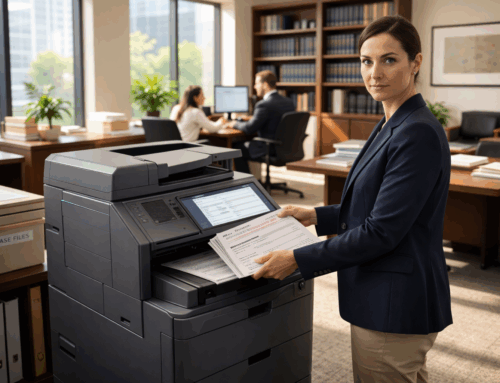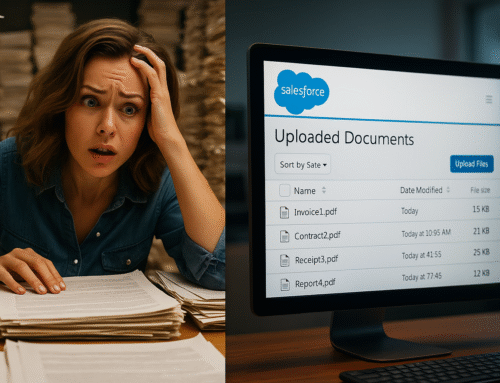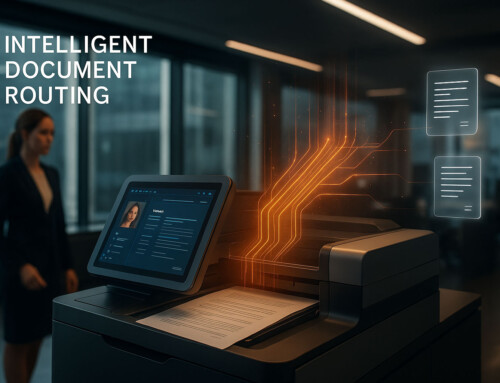



Healthcare organizations are investing heavily in artificial intelligence. OCR, document classification, automated indexing, clinical abstraction, and revenue cycle automation are all positioned as ways to reduce manual work and unlock insight from unstructured data.
Yet many of these initiatives stall, underperform, or quietly get rolled back.
The reason is rarely the AI itself.
AI can’t fix bad document ingestion.
And in healthcare, document ingestion still begins with scanning.
If scanned documents enter the system misrouted, poorly captured, inconsistently indexed, or without governance, no downstream model—no matter how sophisticated—can recover what was lost at intake. Errors don’t disappear. They multiply.
This article explains why healthcare document ingestion remains the single most important determinant of OCR accuracy, AI reliability, audit readiness, and HIPAA compliance—and what hospitals can do about it.
The Myth of “AI Will Clean It Up Later”
A common assumption in healthcare IT is that imperfect inputs can be corrected downstream:
-
OCR will fix readability
-
NLP will infer context
-
AI will classify documents automatically
-
Humans will spot-check exceptions
That assumption does not hold in real hospital environments.
AI does not reconstruct missing metadata.
It does not reliably detect wrong-patient attachments.
It does not enforce access controls retroactively.
And it does not create audit trails where none exist.
Once a document is ingested incorrectly, every system downstream inherits the error.
This is why ingestion quality—not model accuracy—is the limiting factor in healthcare document automation.
Where Document Ingestion Actually Happens in Hospitals
To understand why ingestion fails, it helps to look at where scanning occurs:
-
Front desk registration
-
Referral intake teams
-
HIM departments
-
Centralized mailrooms
-
Emergency departments
-
Backlog conversion projects
-
Post-merger record consolidation
Each location introduces variation in:
-
document types
-
urgency
-
staff training
-
equipment
-
environmental pressure
AHIMA has long emphasized that document imaging is part of the legal health record lifecycle, not a peripheral admin task. Governance must account for these intake realities, not idealized workflows
(AHIMA Health Information Governance).
The Six Ingestion Failures That Break OCR and AI
1. Poor Capture Quality
OCR accuracy begins with image quality. Common issues include:
-
skewed pages
-
low DPI
-
excessive compression
-
faint text from faxed originals
-
shadows, staples, folds
AI cannot reconstruct text that was never captured clearly. Poor scans produce downstream noise that models interpret as signal.
2. Missing or Inconsistent Metadata
AI systems depend on structure. In healthcare, that structure often includes:
-
MRN
-
encounter number
-
document type
-
source
-
department
When metadata is missing or inconsistently applied, AI cannot reliably classify or route documents—even if OCR is technically accurate.
3. Destination Drift
“Scan to email.”
“Scan to desktop.”
“Scan to shared drive for now.”
These workarounds break ingestion governance. They introduce uncontrolled copies of ePHI and sever the link between capture, destination, and audit trail.
HIPAA requires covered entities to implement technical safeguards, including access controls and audit controls, for systems handling ePHI
4. Duplicate and Version Chaos
Rescanning is common when ingestion is fragile. The result:
-
multiple versions of the same document
-
conflicting “final” records
-
uncertainty over which copy is authoritative
AI cannot resolve record authority without clear ingestion rules.
5. Unenforced Access Controls
Shared workstations and shared folders undermine role-based access. AI systems may process data correctly while compliance posture quietly degrades.
6. No Defensible Audit Trail
HIPAA’s Security Rule explicitly requires audit controls to record and examine system activity involving ePHI
If ingestion relies on manual steps, reconstructing “who scanned what, when, and where it went” becomes difficult—sometimes impossible.
Why This Is a HIPAA Problem, Not Just a Data Quality Problem
The moment a document is scanned, it becomes electronic protected health information (ePHI).
That means:
-
it must be included in risk analysis
-
it must be governed by access controls
-
it must be logged and auditable
OCR and AI systems sit downstream of these obligations. They do not replace them.
Why Training and Spot Checks Don’t Scale
Hospitals often try to compensate for weak ingestion with:
-
training refreshers
-
spot audits
-
manual QA
-
exception queues
These approaches help—but they don’t scale under volume.
NIST guidance makes a clear distinction between administrative controls (like training) and technical controls that enforce policy through system design
In high-volume healthcare environments, workflow enforcement matters more than intention.
The Governed Ingestion Layer: What Actually Works
Hospitals that succeed with OCR and AI consistently converge on the same principle:
Scan once. Route directly. Govern automatically.
This model removes discretionary handling of documents and creates a stable foundation for automation.
Key Characteristics of Governed Ingestion
-
No desktop file handling
-
No uncontrolled interim storage
-
Approved destinations enforced at scan time
-
Required metadata captured immediately
-
Automatic logging of user, time, destination, and access
This aligns with NIST SP 800-53 control families around access control and audit logging
Why AI Actually Works Better When Ingestion Is Boring
Well-governed ingestion produces:
-
consistent inputs
-
predictable structure
-
fewer edge cases
-
lower exception rates
This is the environment AI needs.
AI excels when the pipeline is stable.
It fails when asked to compensate for chaos upstream.
Where CCScan Fits (Quietly)
CCScan functions as a document ingestion and orchestration layer rather than “scanner software.”
In healthcare environments, this distinction matters.
CCScan supports:
-
direct scan-to-approved-system workflows
-
enforced routing (EHR, Salesforce, SharePoint, Google Drive, Box, Amazon S3)
-
metadata capture at scan time
-
elimination of endpoint PHI handling
-
consistent audit logging
The value is not speed.
It is predictability and governance at intake.
Learn more at
https://ccscannow.com
A Practical Self-Assessment for Healthcare Teams
Ask these questions:
-
Can you prevent staff from scanning to unapproved destinations?
-
Can you require MRN and document type at scan time?
-
Can you show who scanned a document and where it went within seconds?
-
Can you eliminate desktop PHI handling entirely?
-
Can ingestion rules scale across departments?
If the answer to any of these is no, AI will struggle—no matter how advanced it is.
Conclusion: AI Starts Before the Model
Healthcare AI initiatives don’t fail because models are weak.
They fail because ingestion is unmanaged.
Scanning still determines:
-
data quality
-
audit readiness
-
HIPAA posture
-
clinical trust
Until ingestion is governed, AI will only amplify existing problems.
AI can’t fix bad document ingestion.
But good ingestion makes AI possible.
Your Next Steps
If your organization is investing in OCR or AI while still relying on desktop scanning, shared drives, or manual uploads, ingestion may be the limiting factor.
ccScan helps healthcare organizations build governed ingestion pipelines that support automation, compliance, and scale—without disrupting care delivery.
Explore more at our products page.
References
-
HHS HIPAA Security Rule
https://www.hhs.gov/hipaa/for-professionals/security/laws-regulations/index.html -
HHS Technical Safeguards (PDF)